OFW Rights Against Illegal Recruitment: What Does the Law Say?
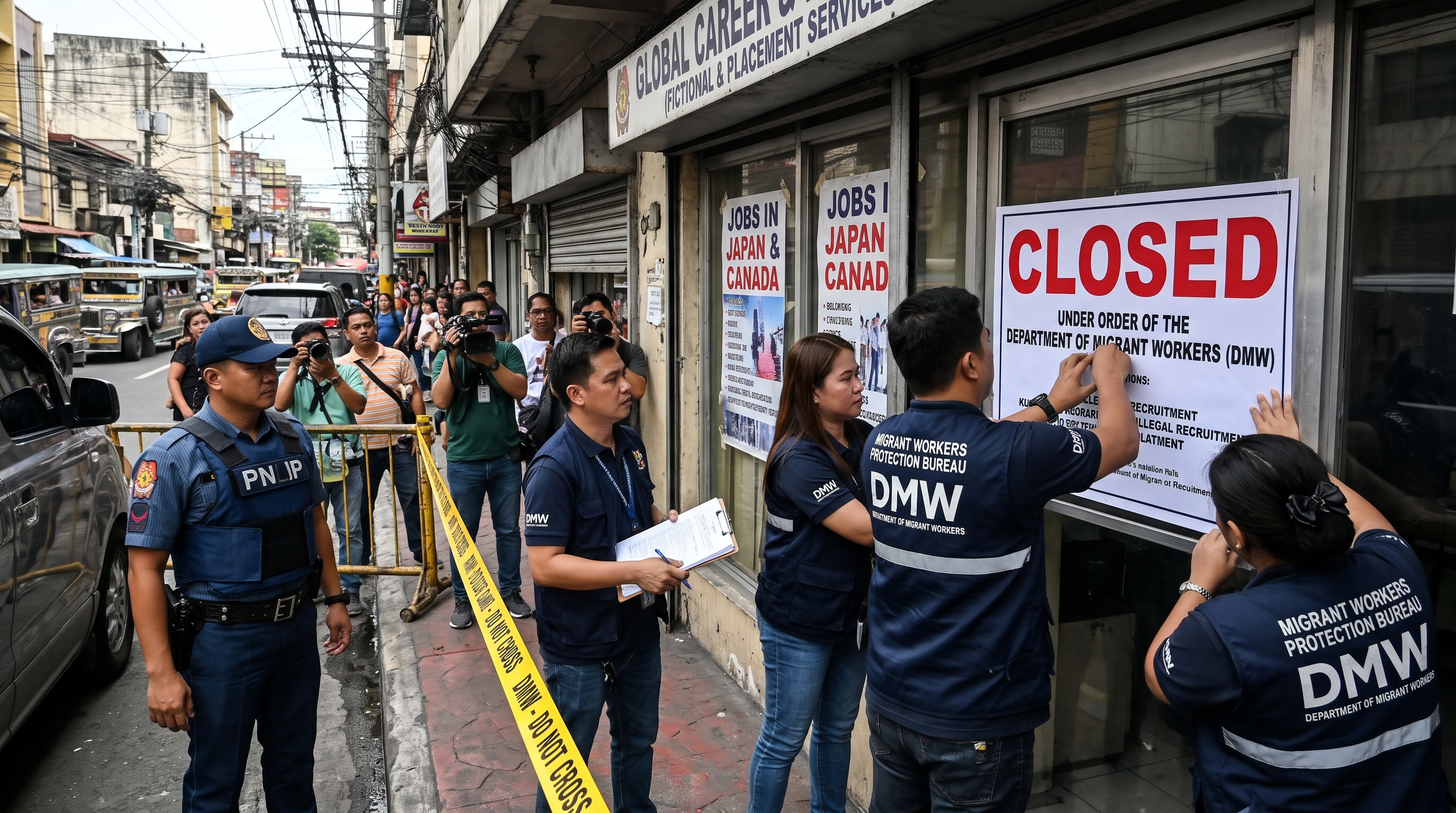
On July 20, 2026, police in Mexico, Pampanga arrested a man the Department of Migrant Workers (DMW) says was behind a recruitment scheme that drew in about 1,700 Filipinos. The jobs on offer were in factories, farms, and hotels in Poland, Lithuania, and the Czech Republic. The cost to apply was a placement fee of ₱80,000 to ₱130,000 per person.
Sit with that number for a second.
For most applicants, ₱100,000 isn't spare cash. It's a loan from a tita, a sold motorcycle, or a year of scrimping. The agency the suspect allegedly worked for, ALJU International Manpower Services, had already been sanctioned for misrepresenting jobs, charging excessive fees, and failing to refund applicants. The DMW eventually cancelled its license. The charges against the suspect are still allegations, and the case is ongoing.
On a recent episode of the My Legal Wiz podcast, Patrick and Atty. Dexter talked through this case and a few others that OFWs run into all the time. What struck us both: in most of these stories, the law was already on the worker's side. The worker just didn't know it.
This guide covers what illegal recruitment is, how much an agency can legally charge you, the warning signs, the penalties, and what to do if it has already happened to you.
What is illegal recruitment? The short answer
Illegal recruitment in the Philippines is either (1) recruiting workers for overseas jobs without a license or authority from the DMW, or (2) a licensed agency committing a prohibited act, such as charging more than the allowed placement fee, lying about the job, or refusing to refund your expenses when you weren't deployed through no fault of your own.
It's a crime under Republic Act 8042, the Migrant Workers and Overseas Filipinos Act of 1995, as amended by RA 10022. When it's done against three or more people, it becomes large-scale illegal recruitment. The law treats that as economic sabotage, and the penalty is life imprisonment.
The two kinds of illegal recruiters
People tend to picture an illegal recruiter as someone with a Facebook page and no office. That's one version. The law covers more.
1) Unlicensed recruiters
If a person or company has no DMW license or authority, any recruiting they do for jobs abroad is illegal. Posting job ads, promising deployment, and collecting your passport and papers all count, whether or not they take your money.
2) Licensed agencies that break the rules
A license isn't a free pass. Under Section 6 of RA 8042, a licensed agency also commits illegal recruitment when it does things like:
- charge or accept more than the allowed fees, or make you sign for more than you actually paid
- give false information about the job, the pay, or the employer
- swap your approved contract for a worse one without DMW approval
- hold on to your passport or travel documents for reasons the law doesn't allow
- fail to reimburse your documentation and processing costs when you aren't deployed and it wasn't your fault
That last one is easy to miss, and it's exactly what ALJU was sanctioned for. A common pattern is that the agency collects fees, stalls for months, then stops answering messages. Not deploying you and not refunding you is a violation in itself.
How much can a recruitment agency legally charge an OFW?
Here are the rules in plain terms:
- The placement fee can't exceed one month of the basic salary in your DMW-approved contract. Basic means base pay only. Overtime, allowances, and bonuses don't count.
- You pay only after you sign the DMW-approved employment contract.
- The agency has to give you an official receipt showing the exact amount you paid.
- Some workers pay no placement fee at all. Household service workers can't be charged one, and neither can seafarers or workers going to countries whose own laws ban recruitment fees.
- A "processing fee," "training fee," or "slot reservation" that's really a placement fee in disguise is still covered by the cap.
One thing to keep in mind: the one-month cap is a ceiling. An agency asking for less isn't automatically legitimate. And any fee demanded before you've seen and signed a contract is a red flag, whatever the amount.
Red flags to check before you pay anything
If you're talking to an agency right now, look for these:
- They want money before you sign a DMW-approved contract.
- The fee is higher than one month of the basic salary they quoted.
- They won't issue an official receipt, or they ask you to send money to someone's personal bank or e-wallet account.
- The offer sounds too good: high pay, no experience needed, quick deployment to Europe.
- They tell you to fly out on a tourist visa and "convert" it to a work visa when you land.
- They can't give you a job order number, or the agency isn't on the DMW's list of licensed agencies.
- They only deal through social media and chat, with no office you can visit.
Before you pay, look up the agency on the DMW website and confirm the job order too. You can also call the DMW hotline at 1348. Ten minutes of checking can save you ₱100,000.
Penalties for illegal recruitment under RA 10022
RA 10022 raised the penalties in 2010, and they are heavy.
Type
What it means
Penalty
Simple illegal recruitment
Committed by one or two people against one or two victims
12 years and 1 day to 20 years in prison, plus a fine of ₱1 million to ₱2 million
Syndicated illegal recruitment
Three or more people working together
Life imprisonment, plus a fine of ₱2 million to ₱5 million
Large-scale illegal recruitment
Committed against three or more victims
Life imprisonment, plus a fine of ₱2 million to ₱5 million
The maximum penalty applies when the victim is under 18 or when the recruiter has no license or authority.
The time limits are long, too. A case for simple illegal recruitment must be filed within 5 years. For large-scale or syndicated illegal recruitment, the window is 20 years. So if this happened to you a few years back, you may still be able to file.
Courts do impose these penalties. In May 2026, the Supreme Court upheld a life sentence for a large-scale illegal recruiter and raised the fine to ₱5 million.
What to do if you've been illegally recruited
- Stop paying. Don't send "one last fee" to release your visa or plane ticket. That request is how these schemes keep going.
- Gather your proof. Keep receipts, bank and e-wallet records, chat screenshots, job ads, the names people used, and any documents they gave you.
- Find the others. If three or more people were recruited by the same group, it's large-scale illegal recruitment. Group complaints carry more weight and the heaviest penalties.
- Report it to the DMW. You can file a complaint against the agency and report illegal recruitment at a DMW office or through the 1348 hotline.
- File a criminal complaint. It can be filed where the recruitment happened or where you live.
- Ask for your money back. Refunds and damages can be pursued as part of the case.
If you're already abroad, go to the Migrant Workers Office (MWO) at the Philippine embassy or consulate. They see these cases constantly.
What if you're sent home before your contract ends?
Not every problem happens at the recruitment stage. On the show, Patrick raised another scenario. You paid a fair fee, signed a proper contract, and flew out. Eight months into a two-year contract, your employer ends it without giving a reason and sends you home. What can you claim?
Atty. Dexterran this one through LEA AI's pro mode, which did six research steps before answering. Here's what it found:
- Your salary for the rest of the contract. In this example, that's 16 months of pay.
- A refund of your placement fee, with 12% interest per year.
- The Philippine agency and the foreign employer are jointly and severally liable under Section 10 of RA 8042. In plain terms, you can go after either one for the full amount.
The full-salary rule comes from the Supreme Court's 2014 decision in Sameer Overseas Placement Agency v. Cabiles. That ruling struck down a clause in RA 10022 that would have capped dismissed OFWs at three months' pay. The Court applied it again in a 2019 case, restoring a worker's full unexpired-term salary after the Court of Appeals had cut it down. Money claims like this are filed with the National Labor Relations Commission (NLRC).
Patrick's take was blunt. Many OFWs in this spot go home, absorb the loss, and file it under sacrifice for the family. Meanwhile there's a claim sitting there with their name on it.
Why we built LEA AI for OFWs
The DMW and the MWOs do help. Dex's point on the show was about numbers: there are hundreds of thousands of OFWs and only so many officers. One-on-one legal help can't reach everyone.
So we tried something. In Hong Kong, My Legal Wiz ran an AI-assisted legal aid session for OFWs, which we believe is the first of its kind. About 50 kababayans used LEA AI instead of lining up to see a lawyer, and they got answers to their questions on the spot. Some MWO and consulate officers now use it too.
One example Atty. Dexter shared came from DMW officers themselves. A Filipino worker died in Saudi Arabia. His PSA records showed two marriages, the second after he converted to Islam. Who gets his bank account and his end-of-service benefit? Atty. Dexter says the office took about two months to settle that question. LEA AI worked through it in 15 research steps in just over a minute, cited the relevant Supreme Court rulings, and checked every citation.
That checking matters. LEA AI runs each citation through a verification step to confirm the case or law exists and actually says what the answer claims. A lawyer at a consulate can click through and read the source.
LEA AI doesn't replace a lawyer. What it does is let you walk into a lawyer's office, or an MWO, already knowing about the one-month fee cap and your right to the unexpired part of your contract. That changes the conversation. As Patrick put it on the show, you're no longer starting from zero. You're asking, "Attorney, here's what I found. Is this the right direction?"
Frequently asked questions
Can an agency collect a placement fee before I sign my contract?
No. A placement fee can only be collected after you sign your DMW-approved employment contract, and the agency must give you an official receipt.
How much is the legal placement fee for OFWs?
At most one month of the basic salary in your DMW-approved contract. Household service workers, seafarers, and workers bound for countries that ban recruitment fees should not be charged a placement fee at all.
What is large-scale illegal recruitment?
Illegal recruitment committed against three or more people. It's treated as economic sabotage and punished with life imprisonment and a fine of ₱2 million to ₱5 million.
How do I check if a recruitment agency is licensed?
Search the agency on the DMW website, ask for the job order number and verify it, or call the DMW hotline at 1348.
Can I get my placement fee refunded?
Yes, in several cases. If you weren't deployed and it wasn't your fault, the agency must reimburse your documentation and processing costs. If you were dismissed without a valid reason, you can claim a refund of your placement fee with 12% interest per year, plus your salary for the rest of the contract.
Is there a deadline to file an illegal recruitment case?
Yes. 5 years for simple illegal recruitment and 20 years for large-scale or syndicated illegal recruitment.
Know your rights before you pay
If you're an OFW, or about to become one, and something about your situation feels off, check it. Type your situation into LEA AI, in English or Tagalog, and you'll get an answer with the laws and cases behind it. The sign-up link is below.
This article is general legal information, not legal advice for your specific case. Use it to understand where you stand, then talk to a lawyer or your nearest DMW or MWO office before you act.
Got a case you want us to cover in a future episode? Leave it in the comments, and tell us where in the world you're working from.

On Demand Legal Knowledge for All Filipinos
Mylegalwhiz gives every lawyer, law student, business owner, and Filipino access to a legal research tool
Sign Up Today


Empowering society with quality and accessible legal software and intelligence
Legal clarity, faster decisions, and a smarter way to work all in one place. MyLegalWhiz is the platform built to help law firms, legal professionals, schools, SMEs, corporations, and government teams access the law, manage legal work, and resolve issues with confidence.